
Cyprus vs Dubai vs Portugal: Where Should You Actually Base Your Business?
When you start researching where to base your business, three names keep coming up: Dubai, Portugal, and Cyprus. Each has its advocates. Each has its drawbacks. And each looks very different once you get past the headline figures.
This is an honest breakdown. Not a pitch for any single jurisdiction, but a genuine comparison of what each option looks like in 2026 for a UK or EU founder with an online business and the flexibility to move.
The Comparison Founders Are Actually Making
Most founders in this conversation are somewhere between two positions: they have worked out that their home country is too expensive, and they are trying to figure out where to go instead. Dubai keeps coming up because the tax rate sounds compelling. Portugal used to come up because of the NHR. Cyprus tends to come up later, once people dig past the headline.
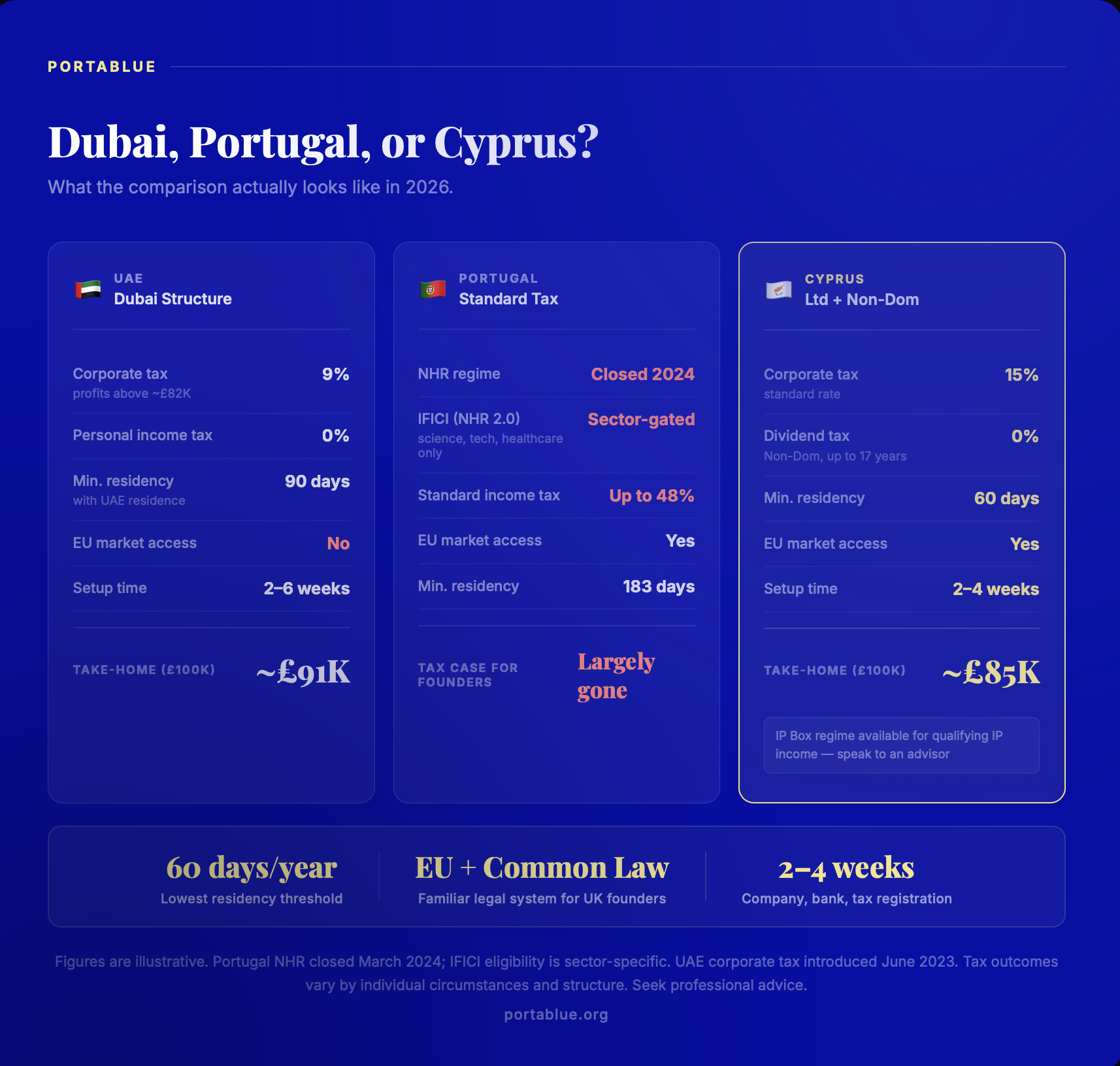
Here is what the comparison actually looks like across five dimensions.
1. Tax Efficiency
Dubai. The UAE has no personal income tax. That remains true in 2026. Corporate tax was introduced in June 2023 and currently sits at 9% on taxable profits above AED 375,000, roughly £82,000. Below that threshold, the rate is 0%. For a founder extracting profit as dividends, there is no personal tax on those either. On £100,000 in profit, a straightforward UAE structure leaves you with approximately £91,000 after corporation tax.
Portugal. The NHR regime, which gave qualifying new residents a 20% flat tax rate or foreign income exemptions for ten years, closed to new applicants in March 2024. It was formally replaced by IFICI (the Tax Incentive for Scientific Research and Innovation, often called NHR 2.0) from January 2025. IFICI offers a 20% flat rate on Portuguese-sourced income, but it is targeted at highly qualified professionals in sectors such as science, technology, healthcare, and clean energy. For most online founders and solopreneurs, IFICI eligibility is unlikely without specific academic credentials and a qualifying role in one of those sectors. Without it, Portugal's standard progressive income tax can reach 48% at higher income levels, with social security contributions on top. For most founders, Portugal is now a lifestyle decision rather than a tax strategy.
Cyprus. Standard corporate tax sits at 15%, one of the lowest rates in the EU. Under the Non-Dom regime, eligible founders pay 0% on dividends received from their company for up to 17 years. On £100,000 in profit, a Cyprus-structured founder keeps approximately £85,000. The regime is legislated, has survived EU scrutiny, and has been actively promoted by the Cyprus government for years.
On pure numbers, Dubai can edge ahead. The more useful question is whether tax alone should drive the decision.
2. EU Market Access
Dubai. The UAE is outside the EU. For most founders running remote services or SaaS businesses with UK or EU clients, this rarely creates a day-to-day problem. Where it starts to matter is regulatory: financial services, certain professional services, businesses seeking EU-based contracts, and founders planning future fundraising from European institutional investors. A UAE company is a UAE company. That is a legitimate consideration, not a dealbreaker, but worth factoring in honestly.
Portugal. EU member state with full single market access. For EU-based businesses, that carries real value: VAT registration, passporting, and the credibility signal of an EU entity for clients and partners.
Cyprus. EU member state, full single market access, and a common law jurisdiction. That last point matters specifically to UK founders: contracts, company structures, and legal concepts translate far more cleanly into Cyprus's legal system than they would in a civil law country like Portugal or most of continental Europe. For a UK founder restructuring, Cyprus feels legally familiar in a way that few other EU jurisdictions do.
3. Ease of Setup
Dubai. Company formation requires choosing between mainland and free zone structures, each with different ownership rules, cost structures, and banking implications. Setup times vary but typically run from two to six weeks. The process is manageable, but it has more moving parts than most founders expect when they first start researching.
Portugal. Company formation within the EU is straightforward. But if you are also navigating a visa application, tax registration, and IFICI eligibility, timelines extend and complexity rises. Establishing IFICI eligibility requires documentation of professional qualifications and sector fit before the tax benefit is confirmed.
Cyprus. Company formation typically takes two to four weeks. Bank account facilitation, tax registration, and the Non-Dom application can run in parallel. There is no minimum share capital requirement for a standard Cyprus limited company. The professional services sector on the island is built around exactly this kind of structure, which means the process is well-documented and well-handled.
4. Residency Requirements
Dubai. To establish genuine UAE tax residency, you generally need a minimum of 90 days per year in the UAE if you hold UAE residence, and you cannot spend more than 183 days per year in any single other country. The UAE digital nomad visa requires proof of at least USD 3,500 per month in income from outside the country. These are workable thresholds, but they require genuine presence, not just a registered address.
Portugal. Standard Portuguese tax residency requires 183 or more days per year in the country, or establishing your primary habitual residence there. Without NHR or IFICI benefits, meeting that residency threshold means paying standard progressive rates, which significantly changes the calculation.
Cyprus. The Non-Dom regime requires a minimum of 60 days per year in Cyprus, with no more than 183 days in any single other country. That is the most founder-friendly residency threshold in this comparison. You are not being asked to relocate permanently. Sixty days of genuine, documented presence across the year is a reasonable commitment for founders who already travel for work.
5. Cost of Living and Lifestyle
Dubai. High cost of living, particularly accommodation. A fast-moving, transient expat environment with excellent infrastructure and warm weather year-round. For founders who want proximity to Gulf capital or deal flow from emerging markets, the location makes sense. For a UK founder running a remote business whose clients are in London or Amsterdam, it is often more infrastructure than the setup requires.
Portugal. Strong quality of life, lower cost of living than most of Western Europe, a genuine digital nomad community, and a climate that most people find hard to argue with. In lifestyle terms, Portugal remains one of the most appealing countries in Europe. The tax case, however, has materially weakened. Founders choosing Portugal in 2026 are largely choosing it for reasons unrelated to their tax structure.
Cyprus. Lower cost of living than Dubai. A Mediterranean climate, English used widely across both business and daily life, and a growing founder and expat community. It is not as large or cosmopolitan as Dubai or Lisbon. What it offers instead is a functional, low-friction base with a professional services infrastructure that is purpose-built for exactly this type of founder structure.
The Honest Assessment
For a UK or EU founder running an online business with flexibility on where to be based, Cyprus is one of the strongest all-round options available. Not because it offers the lowest tax rate, and not because it is the most exciting country. But because it combines EU incorporation, a 60-day annual residency threshold, a common law legal system, English as a primary business language, a two-to-four week setup process, and a tax framework that is mature and purpose-built for founders who move.
Dubai is the right answer if your industry, clients, or growth strategy genuinely pull you toward the Gulf. It is a legitimate jurisdiction with real advantages. It is not the right answer simply because the headline tax figure looks good, particularly once you factor in the 9% corporate tax, the residency requirement, and the loss of EU presence.
Portugal remains an appealing country to live in. For founders who genuinely want to be there and who qualify for IFICI, the structure still works. For most online founders, the tax case that drove so much attention to Lisbon between 2017 and 2024 is no longer the same proposition.
The right decision depends on your actual situation: where your clients are, how much time you can realistically commit to a new base, what your business structure looks like, and what matters to you beyond the tax rate. PortaBlue helps founders work through exactly that analysis before arriving at a recommendation.
Tax outcomes depend on your individual circumstances, residency history, and business structure. PortaBlue connects you with trusted Cyprus-based legal and tax professionals to ensure your setup is structured correctly. This article is for informational purposes only and does not constitute tax or legal advice.
Ready to work out which structure is right for your situation? Apply for early access →